
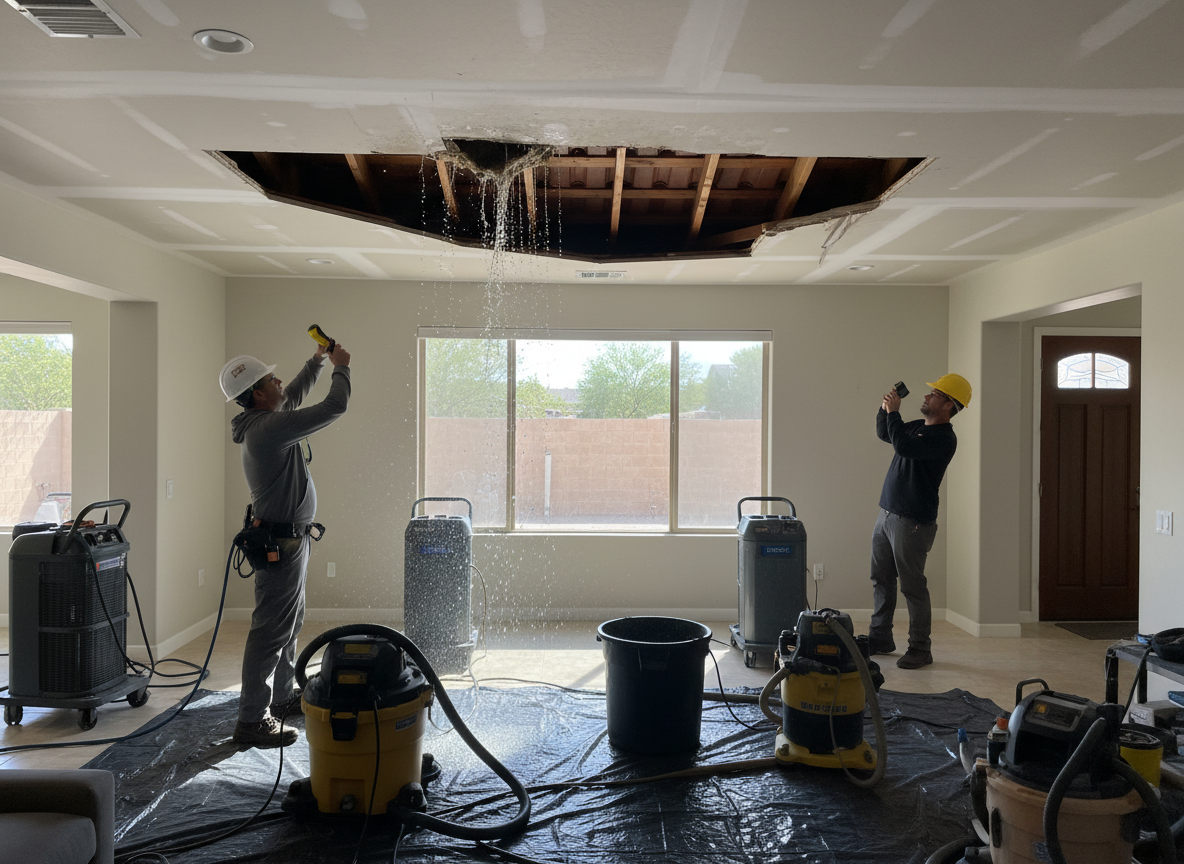
Fountain Hills homes in Downtown Fountain Hills and Fountain Hills Heights often feature tile roofs installed over older sheathing that can crack after years of intense sun followed by sudden monsoon downpours. When leaks develop, water travels along rafters and pools in attics before showing on ceilings, especially in single-story ranch homes common to Maricopa County. Technicians must trace moisture with meters because stucco walls and vaulted ceilings hide saturation that later causes mold if left untreated. Extraction begins at the leak point, followed by targeted drying to protect insulation and electrical runs typical in 1980s-2000s construction here.
Hot desert days speed surface evaporation while trapping moisture deeper in wood and drywall, so equipment placement matters more than in milder climates near Scottsdale or Mesa. After monsoon events, crews frequently find water that has wicked into perimeter walls near Fountain Park or along slopes where drainage concentrates runoff. Removing wet insulation and treating affected framing prevents recurring issues once the roof is patched. Homeowners in these neighborhoods benefit from same-day response because afternoon storms can deliver enough volume to overwhelm standard gutters on many properties.
Code considerations in Fountain Hills require proper ventilation and moisture barriers when replacing ceiling materials after a roof leak. Skipping these steps leads to future condensation problems during the mild winter months when indoor heating meets cooler roof decks. Restoration focuses on returning the home to pre-loss condition without unnecessary demolition, using dehumidification calibrated for the low-humidity desert air that aids faster drying once bulk water is gone.
Technician insight
In Fountain Hills the thing that catches most people out with roof leak water damage restoration is how quickly monsoon water travels along the paper underlayment on tile roofs and soaks the entire length of a rafter before anyone notices a ceiling stain. Homes in Fountain Hills Heights built on slopes see this more often because runoff concentrates at the lower eaves.
Monsoon Leak In Downtown Fountain Hills
Heavy rain entered through a cracked tile near the ridge on a 1990s home. Water had traveled fifteen feet along rafters and saturated insulation above the living room. Extraction and targeted drying prevented mold growth in the vaulted space, and ceiling drywall was replaced once moisture readings stabilized.
Roof Leak Water Damage Restoration Services We Offer
✓Tile Roof Leak Detection
Non-invasive moisture mapping and camera inspection to locate entry points under concrete or clay tiles common on Fountain Hills homes.
✓Attic Insulation Removal and Drying
Extraction of saturated blown-in or batt insulation followed by drying of rafters before reinstallation or replacement.
✓Ceiling Drywall Repair After Roof Leak
Removal of water-damaged drywall, treatment of framing, and replacement with moisture-resistant materials suited to desert temperature swings.
✓Monsoon Water Extraction
Rapid pump-out and containment of bulk water that enters during heavy summer storms affecting properties near the Fountain Hills Fountain.
✓Structural Drying for Vaulted Ceilings
Placement of air movers and dehumidifiers calibrated for open ceiling designs found in many Fountain Hills Heights residences.
Roof Leak Water Damage Restoration Cost in Fountain Hills, AZ
| Service | Typical Range | What Affects It |
|---|---|---|
| Initial Assessment And Moisture Mapping | $150–$350 | Larger homes or multiple leak points increase time required. |
| Attic Water Extraction | $400–$900 | Depends on volume and accessibility through access points. |
| Equipment Drying Per Day | $200–$450 | Vaulted ceilings or thick insulation extend drying time. |
| Drywall And Insulation Replacement | $800–$2,200 | Square footage and material grade affect final cost. |
Ranges are typical for Fountain Hills, AZ and confirmed with an exact written quote before any work starts.
How it works
- 1
Emergency Assessment
Arrive on-site, document the leak source, and map moisture migration through ceilings and walls using meters and thermal imaging.
- 2
Water Extraction
Remove standing water from attics and affected rooms with pumps and vacuums to stop further saturation of building materials.
- 3
Drying And Monitoring
Set up drying equipment and check daily moisture levels until readings return to normal for the desert climate.
- 4
Repairs And Restoration
Replace damaged drywall and insulation, then coordinate with roofers for permanent leak fixes before final cleanup.
Pricing
Pricing varies by extent of hidden damage and number of affected rooms. Upfront written estimates provided after inspection.