
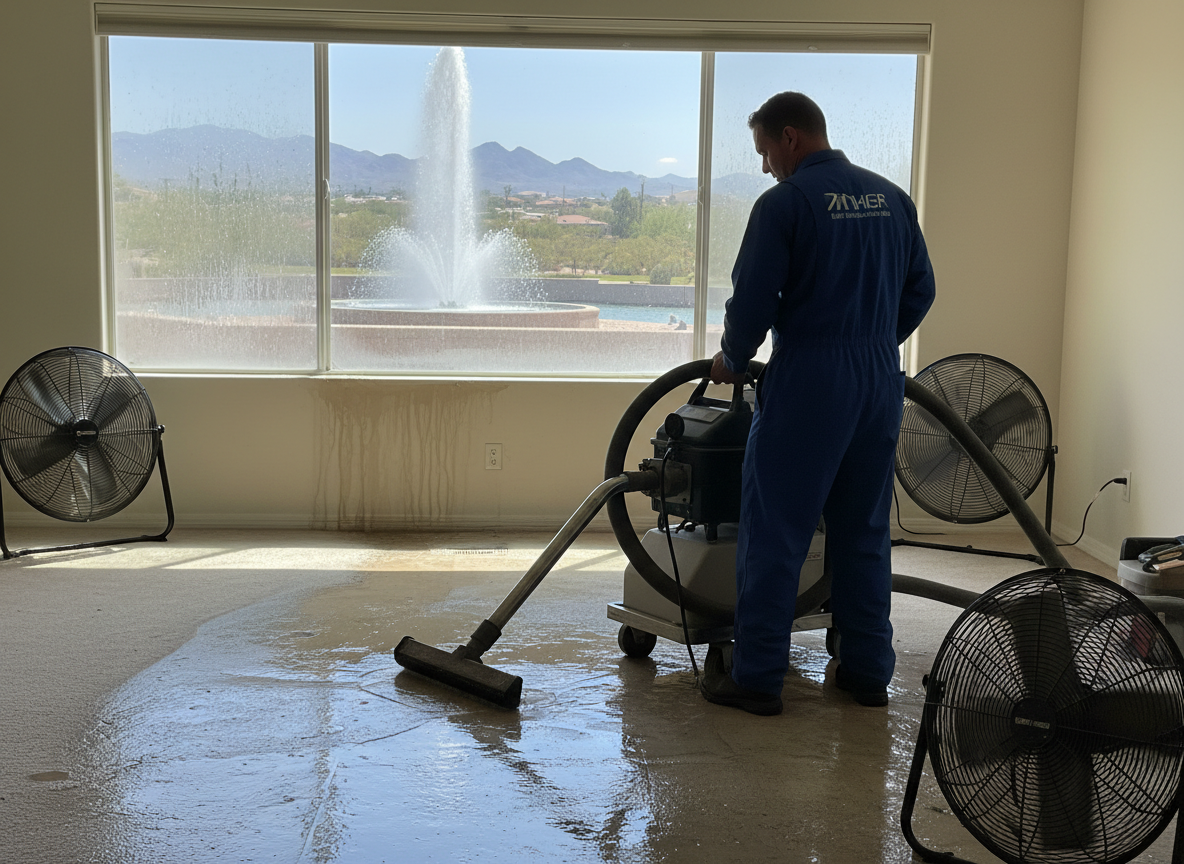
Fountain Hills sits in a hot desert climate where sudden monsoon rains can overwhelm drainage around older single-story stucco homes built in the 1980s and 1990s. Water often pools under tile floors and behind baseboards in Fountain Hills Heights because the rocky terrain limits natural runoff. Technicians must pull carpet and pad quickly before moisture migrates into the concrete slab common in Maricopa County construction.
Nearby Scottsdale and Mesa properties share similar irrigation and roof-leak patterns, yet Fountain Hills homes face extra challenges from wind-driven rain hitting the Fountain Park side of the neighborhood. Extraction crews use truck-mounted pumps rated for 200-plus gallons per minute to handle standing water from burst supply lines or overflowing fountains. Failing to remove water within the first 24 hours allows mold to take hold in the dry but humid microclimates created by evaporative coolers.
Local codes in Maricopa County require proper disposal of extracted water when it contains sediment from desert washes. Crews document moisture readings at multiple depths in drywall and subfloors before leaving the site to satisfy insurance adjusters who routinely review claims from this zip code.
Technician insight
In Fountain Hills the thing that catches most people out with Water Extraction & Removal is how fast monsoon water travels under stucco and into the slab because the rocky soil in Fountain Hills Heights does not drain. Homeowners often wait until they see ceiling stains instead of checking baseboards after the first heavy rain, which turns a same-day extraction into a multi-day drying job.
Fountain Hills Heights Slab Leak
A supply line failed under tile in a 1987 home near the Fountain Hills Fountain. Water had already reached the living-room slab edge and begun wicking into drywall. Crews extracted 180 gallons, removed the pad, and ran drying equipment for three days until readings returned to normal.
Water Extraction & Removal Services We Offer
✓Carpet and Pad Water Extraction
Removes standing water from carpet and underlayment in Fountain Hills homes before mildew sets in behind baseboards.
✓Slab Leak Water Removal
Extracts water that has wicked under tile or hardwood from supply-line failures common in 30-year-old Fountain Hills Heights properties.
✓Monsoon Flood Extraction
Handles rapid water removal after heavy rains that collect against stucco foundations near the Fountain Hills Fountain.
✓Appliance Leak Extraction
Targets water from washing-machine or water-heater failures that spread across laundry rooms in Downtown Fountain Hills residences.
✓Crawl Space Water Pumping
Clears pooled water beneath homes where desert terrain and poor grading allow moisture to collect after winter rains.
Water Extraction & Removal Cost in Fountain Hills, AZ
| Service | Typical Range | What Affects It |
|---|---|---|
| Carpet Water Extraction | $250–$550 | Varies with room size and whether pad must be discarded |
| Slab Leak Extraction | $400–$900 | Higher when water travels under multiple rooms |
| Monsoon Flood Extraction | $350–$750 | Depends on depth and sediment load from desert runoff |
| Crawl Space Pumping | $300–$600 | Affected by access points and standing water depth |
Ranges are typical for Fountain Hills, AZ and confirmed with an exact written quote before any work starts.
How it works
- 1
On-Site Assessment
Technician arrives from the Ave of the Fountains location, maps water migration through stucco walls and slab edges, and records moisture levels.
- 2
Water Extraction
Truck-mounted equipment pulls standing water from carpets, tile, and low areas while protecting nearby Fountain Park landscaping from runoff.
- 3
Initial Drying Setup
Air movers and dehumidifiers are placed to begin evaporating residual moisture from drywall and subfloors before secondary damage occurs.
- 4
Final Moisture Verification
Readings are taken again and documented for Maricopa County insurance requirements before equipment is removed.
Pricing
Cost depends on water volume, affected square footage, and access under tile or slab; on-site assessment required.